
This site uses cookies. By continuing to browse the site, you are agreeing to our use of cookies.
OKWe may request cookies to be set on your device. We use cookies to let us know when you visit our websites, how you interact with us, to enrich your user experience, and to customize your relationship with our website.
Click on the different category headings to find out more. You can also change some of your preferences. Note that blocking some types of cookies may impact your experience on our websites and the services we are able to offer.
These cookies are strictly necessary to provide you with services available through our website and to use some of its features.
Because these cookies are strictly necessary to deliver the website, refusing them will have impact how our site functions. You always can block or delete cookies by changing your browser settings and force blocking all cookies on this website. But this will always prompt you to accept/refuse cookies when revisiting our site.
We fully respect if you want to refuse cookies but to avoid asking you again and again kindly allow us to store a cookie for that. You are free to opt out any time or opt in for other cookies to get a better experience. If you refuse cookies we will remove all set cookies in our domain.
We provide you with a list of stored cookies on your computer in our domain so you can check what we stored. Due to security reasons we are not able to show or modify cookies from other domains. You can check these in your browser security settings.
These cookies collect information that is used either in aggregate form to help us understand how our website is being used or how effective our marketing campaigns are, or to help us customize our website and application for you in order to enhance your experience.
If you do not want that we track your visit to our site you can disable tracking in your browser here:
We also use different external services like Google Webfonts, Google Maps, and external Video providers. Since these providers may collect personal data like your IP address we allow you to block them here. Please be aware that this might heavily reduce the functionality and appearance of our site. Changes will take effect once you reload the page.
Google Webfont Settings:
Google Map Settings:
Google reCaptcha Settings:
Vimeo and Youtube video embeds:
The following cookies are also needed - You can choose if you want to allow them:
Sailing Freely
I came across this image earlier today in the depths of my archives. As I’ve mentioned before, I usually have several book projects simmering at once, each in different stages of completion. That’s just how I roll. Ideas brew, evolve, and occasionally leap ahead of the pack.
Right now, I’m just about to launch a brand-new book (more on that very soon), and at the same time, I’ve just begun working on a fresh photography book — this one focusing on some of my absolute favorite places in the southern Swedish region of Österlen.
One of the great joys of this chapter in life is being able to sail freely between creative projects, without the burden of rigid deadlines. To work when inspiration strikes (which it does daily, believe me), to pause when needed, and to let each project unfold in its own rhythm. But also having the time and freedom to travel — both physically and creatively — wherever curiosity leads and whatever fills my sails.
Österlen, with its mix of sea, sky, forest, farmland, and small villages, continues to heal, inspire, and surprise me. It’s both cultivated and wild, still and ever-changing — and I can’t wait to share what I see through my lens and what I feel in my heart.
Stay tuned. More to come.
Irresistible Puppy
Charlotte and I ran into this little rascal after the concert at Slottsträdgårdens Kafé tonight. Some kind of Havanese and Shih Tzu mix. Shaken, not stirred.
There’s just something about puppies – and basically all mammalian young (and even some reptiles, like baby turtles) – that makes them utterly irresistible. Nature’s way of hacking our brains with pure adorableness.
According to Konrad Lorenz’s Kindchenschema, we’re biologically wired to respond to infantile features – big eyes, round heads, tiny noses – with affection and care. Attachment theory also plays a role, as our brains are tuned to bond and nurture anything that triggers a sense of vulnerability or dependence. And then there’s the reward theory of cuteness, which suggests that seeing adorable creatures activates our brain’s dopamine system – like a hit of feel-good nature-generated clickbait.
Return from Riga
Back in Malmö.
My one-word takeaway from this trip? Melancholy. I recognize it from visits to other Eastern European cities: Gdańsk, Tbilisi, Sofia, Belgrade, Zagreb, Tirana, Vilnius, Tallinn.
The younger generation doesn’t carry the weight of nearly seventy years of political oppression and social tyranny as heavily as the older Latvians do. Yet the melancholy lingers in them too. It takes effort to coax out a smile. Public laughter is rare. Seriousness reigns.
Authoritarian rule has embedded itself in the DNA of society – clearly spanning generations. Suspicion and skepticism are ever-present – instinctive, almost reflexive.
Yet somehow, I’m drawn to this melancholy. It’s brutally honest – non-pandering and unvarnished. Just like many of the old buildings and houses in Riga. Including the old railway station, which provided me with a few interesting views.
As I grow older, I find myself more introspective and reserved, less interested in spending time as the outgoing and superficial individual of yesteryear. As Popeye once said, “I yam what I yam, and that’s all what I yam.”
Midsummer in Riga
2025 has already thrown plenty our way, and it’s only June. So we’re choosing a quieter kind of celebration – Riga-style – with cobblestone walks and slow, soulful mornings. That said, we do wish all friends and family a happy Midsummer, however, wherever and whoever you celebrate it with! ☀️
Riga, Latvia
Meanwhile, in Riga…
There’s something about coming back to a familiar city that flips a quiet switch in my brain — a concoction of curiosity, calm, and perhaps a bit too much trolley coffee. Travel, for me, has never been about box-ticking, but about absorbing a vibe and seeking the soul of a destination.
Some places I visit once and feel done with. Others, like Riga, keep calling me back. Maybe because I have a few drops of Baltic blood in me, on my paternal grandfather Bill’s side of the family.
I’ve printed over a dozen of my books here in Latvia, so the capital has long been woven into my creative process.
The streets, the cafés, the mix of Art Nouveau facades and Soviet leftovers — Riga has plenty of interesting layers. The past lingers here, but never smothers the present.
These days, with the world spinning off-axis — wars in the Middle East and in Eastern Europe — you’d think travel choices would feel limited. But that’s the paradox. Sometimes, the most eye-opening experiences are next door. From Sweden, cities like Riga offer a refreshing shift in perspective without the trepidation of long-haul journeys.
So here I am again — walking these streets, camera in hand — reminded that I don’t need to wander a great distance to feel like I’m far away.
Broloppet 2025
This is from today’s Bridge Run which was nothing short of spectacular! ♂️ Celebrating the 25th anniversary of the opening of the Öresund Bridge, close to 40,000 runners — from casual joggers to seasoned pros — crossed from Denmark over the bridge to Sweden. As a very casual runner myself (≈15k/week), it was incredibly inspiring to witness these runners’ energy and determination, especially at the finish line after 21k in beautiful Sibbarp!
Kåseberga, Sweden
One of the greatest privileges of my life is not just being able to travel to some of our planet’s most remarkable places – which I’ve done for over 45 years – but also being able to document so many fleeting moments there.
Photography, for me, has never been just about aesthetics. It’s about witnessing something real, something transient, and translating my impressons into a visual memory that often outlives the moment itself (and my own fading ability to remember places vividly).
This past week, I had the good fortune to revisit one of the most naturally beautiful corners of Sweden: Kåseberga, a small fishing village perched along the southeastern coast in Österlen.
I was once again hosted by buddy and fellow visual artist, Henry Arvidsson – a generous soul with a great eye, sharp wit, and a passionate photographer bar none.
Historically known for its fishing heritage, the village of Kåseberga dates back to at least the late 17th century. Nestled between open farmland and the Baltic Sea it still retains the weathered charm of an authentic maritime community.
Though large-scale fishing has diminished, the essence remains – red-painted boathouses, sun-bleached ropes, and the quiet creak of wooden boats bobbing in the harbor.
During autumn storms, Kåseberga also draws a small crowd of enthused surfers. And while it may not be Hawaii’s North Shore, the waves rolling in off the Baltic offer just enough force for a short ride to the rocky shoreline. In younger years, I was one of those who waited patiently on the board, watching the horizon for the next break to arrive.
But Kåseberga’s allure goes beyond its seafaring soul. Rising high above the village stands Ales Stenar, an ancient megalithic monument made up of 59 massive stones arranged in the shape of what some think is a Viking ship.
Measuring roughly 67 meters in length, the formation dates back around 1,400 years, though theories about its actual purpose abound. Some think it functioned as a burial site, others suggest it was a solar calendar. Whatever the truth may be, it adds a sense of myth and mystery to the already cinematic setting.
The light in Österlen is its own kind of poetry. It can shift in a matter of minutes – fog lifting off the sea to reveal golden fields, or dark clouds drawing a curtain across the cliffs.
For a photographer, it’s a dream and a challenge. You have to stay alert, responsive, and willing to run uphill at a moment’s notice when the light breaks just right or a flock of birds slices across the horizon.
Having Henry there to share the experience was a gift. He once again opened his home and generously shared local insights that only someone with his visual sensibility and connection to the area could provide. which in no small way is evident in his new book, aptly titled Kåseberga.
We spent days with our cameras ready and our evenings reflecting on life and art over a responsible number of ice-filled glasses of bourbon.
In a world increasingly saturated with disposable images, it’s easy to overlook places like Kåseberga. It’s not loud or overly self-promoting.
It doesn’t scream for attention. It simply exists, quietly and confidently, shaped by centuries of wind, salt, and stories. And in doing so, it reminds me that beauty doesn’t always announce itself – it often lingers in silence, in the grain of weathered wood, or the rhythm of waves gently meeting the shore.
And I’m lucky – truly lucky – that I get to not only see these places but also capture them, preserve them, and share them.
So thank you, Kåseberga. And thank you, Henry. Hopefully, I’ll be back someday.
Söderåsens National Park
After a rigorous, early morning workout at our local gym, Charlotte and I headed to Söderåsens National Park – about an hour northeast of Malmö – for a 7.5k hike. Just as we were about to begin, this wonderful swan family appeared.
The park is popular, and we’ve both been there before. Fortunately, for most of this visit, we had the lush forest to ourselves and enjoyed our lunch with a symphony of birds and critters around the picnic table – a truly great way to start the week.
Gothenburg Views
I took this view of Järntorget and Linné-området the other day from our hotel room on the 20th floor at Hotell Draken in Göteborg. It rained off and on for most of our stay there with the exception of this one sunny morning. At some point, possibly this fall, I will begin working on a book about Göteborg, or, as the city is so thoughtfully translated into English, Gothenburg.
Book Signing for “MALMÖ”
I’ll be having a book signing again today at our local supermarket, ICA MAXI VÄSTRA HAMNEN, from 4-6 pm. Come by, grab a signed copy of my new book “MALMÖ” and get a free poster for every book you buy. Posters are in A3 format and are part of a series with motifs from Västra Hamnen, the part of Malmö where we’ve been living for more than 20 years. Not time to come by? Well, you can order the book from Bokus, Adlibris, Akademibokhandlen, and even Amazon if you’re viewing this from the US or somewhere else outside the EU.
TWO DAY GRADUATION CELEBRATIONS
Charlotte and I have just wrapped up a two-day, two-party graduation extravaganza in Gothenburg with dozens of old friends, delicious food, and — if we’re being totally honest — more than a few too many champagne flutes and other thirst-quenching but utterly unhealthy beverages. Wishing Theodor Johansson and Alice Lindahl a bright future and the best of luck in all their forthcoming endeavors.
Swedish High School Graduation Celebrations
One of Sweden’s wildest, loudest, and most joyful traditions is back on the streets today here in Göteborg. Shot these scenes in downtown Göteborg this afternoon, where I captured some of the annual “studentflak” celebration — where high school seniors ride around town in decorated trucks, blasting music, honking horns, dancing, and toasting their graduation. Girls in white dresses, guys in suits or blazers, waving banners, throwing confetti, and marking the end of mandatory school with pure euphoria. It’s chaotic, proud, and so very Swedish After the wild ride, most graduation students return home where friends and family await to give presents and hugs. We were at one wonderful graduation reception yesterday, and there will be one again today before we head back home to Malmö tomorrow afternoon.
Svalbard Scenes
Here are a few scenes from Spetsbergen and a few other places shot during the trip to Svalbard. All shot handheld using my now three-year-old iPhone 14 and a 249 gram drone.
Svalbard
Meanwhile, in Longyearbyen, Svalbard.
I’ve wanted to visit Svalbard ever since I first heard about the Arctic archipelago back in the late 1980s.
During my time in Sweden’s Lapland at Hotel Riksgränsen, I went on a couple of memorable trips to the Lofoten Islands in Norway and twice made it all the way up to Tromsø, among other things, to eat the legendary monkfish served at the city’s classic Peppermøllen eatery.
I didn’t get any farther north — not until now.
A couple of months ago, when my buddy and fellow photographer Henry Arvidsson and I were having coffee in Malmö, we decided that Svalbard would be an awesome place to visit in the spring.
To experience the mighty, raw nature, visit abandoned mines, and maybe — just maybe — catch a glimpse of, and even photograph, a scruffy polar bear from a safe distance would be quite the feather in the cap.
We didn’t get any photos of a live bear, and the ongoing ice breakup threw wrenches into our excursion plans. But we still got to experience magically beautiful nature from the ground, the air, and the sea. We also ate some great food, including whale.
Longyearbyen is a former coal mining town where anyone from anywhere can move without a visa. Maybe that’s why the town is populated by people from all kinds of countries.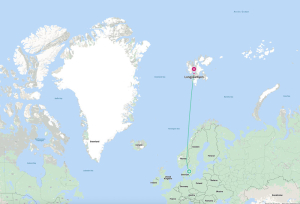
Our hotel is called Polarrigg and is owned by Greg, a Greek guy who otherwise runs a nightclub on the island of Mykonos. The front desk team comes from Bosnia, Australia, and Scotland. The restaurant staff is from Russia, the Philippines, Ukraine, and Romania. At the diner Kroa, most of the workers are from Thailand, and Vlad, the guy who drove the boat over the choppy Isfjorden today, was Russian, while the guide was from South Africa.
Wages are high, taxes are low — just 15%. Rents are said to be on par with apartments in Stockholm, yet here you’ll find most of the conveniences of any small town.
The local supermarket is huge and well-stocked and sits close to Nordpolet, the only place on the archipelago where you can buy alcoholic beverages.
There’s definitely a special spirit here — an atmosphere I recognize from my time at Hotel Riksgränsen, where I bartended and painted, and where almost everyone who worked there came from far beyond Kiruna, the nearest municipality.
People we’ve spoken with here talk about Svalbard’s special vibe and how it’s intimately connected to the distance from “civilization,” far away from the squeak of the hamster wheel.
They like living so close to nature and sharing the environment with Arctic foxes, wild reindeer, eiders, sea eagles, polar bears, walruses, and whales. I can understand their thinking.
I feel really happy having visited yet another exotic spot on my bucket list.
A (naive) Flicker of Hope
This is from a press trip to Jordan that included scuba diving in the warm, crystalline waters of the Red Sea near Aqaba, traversing the surreal desertscapes of Wadi Rum, and hiking through Wadi Musa – the legendary Valley of Moses – where the ancient city of Petra lies etched into rose-hued cliffs.
Jordan revealed itself as a land of stark and stunning contrasts: silent deserts and noisy souks, pristine coral reefs and ancient ruins worn smooth by centuries of footsteps. But it was this quiet moment in Amman – a dusk-drenched scene – that lodged itself in my mind.
There, beneath the call to prayer and the fading evening light, I felt a flicker of something unexpected: hope. Hope that maybe, just maybe, people of all faiths – and the godless, like me – might one day realize how absurdly self-destructive and potentially cataclysmic it is to keep tearing each other apart over whose version of the truth is the right one.
Then again, as Eisenhower so famously warned in his farewell address in 1961, just three days before John F. Kennedy was inaugurated as the 35th President of the United States, the military-industrial complex – that cozy little partnership between weapons manufacturers and the politicians they sponsor – has no interest in peace. Peace doesn’t sell. Peace doesn’t generate quarterly growth. Peace doesn’t get you re-elected – not with patriotic slogans, war parades, and ceremonial flyovers. That’s the war business for you. And business is booming.
Österlen
There’s something magical about this time of year in Sweden’s Österlen — when the canola fields explode in a sea of brilliant yellow, some even stretching all the way to the Baltic Sea. It’s a color so intense, so joyful, it almost hums. I’ve always loved this golden season — the contrast between the endless blue above, the shimmering sea beyond – together reminding me of the Swedish flag – and the vibrant blossoms swaying in the breeze. A visual feast. A painter’s and a landscape photographer’s dream.
A Curious Encounter in Österlen
It’s soon time to return to Österlen. This is, in my opinion, the best time of year to experience it. I already have a curated collection of 350+ images from this part of Sweden. So after this trip, there is no doubt in my mind that I’ll have enough to create a book about Österlen.
Creative Kinship
When I created these illustrations of artists that have somehow had a profound impact on my life and my creativity, I wanted them to look iconic, albeit scattered across time and artistic disciplines. These artists are not my heroes, but I do feel we are distant kin. Each wrestled with their addictions and/or creative obsessiveness, leaving behind a legacy defined by brilliance but also by their flaws and humanity.
I can’t compare myself to them in talent. That would be absurd. But I do relate to them in spirit. In the hunger. In their aches and ceaseless striving. In the need to make something – anything – that connects and feels real.
Anthony Bourdain – more than the others, I can easily relate to Bourdain as the restless nomad with a passport in one hand, a pen in the other, and always a glass of something soul-soothing nearby. His shows were never only about food – they were also about people, politics, and place. Like Bourdain, I cooked professionally for a while. I know the rhythm of a busy kitchen, the joy of a shared meal after a long shift, the pride in being able to plate beautifully amid utter chaos. The ugliness that goes on behind the scenes at most kitchens. The camaraderie.
I, too, have been to some pretty remote corners of the earth, and Tony’s way of seeing and experiencing the world–with curiosity, humility, humor, and a healthy dose of cynicism–resonates deeply with me. Especially in places and locations where meals are central to socializing and not just a meaningless pit stop to fill the belly while leaving the heart empty.
Charles Bukowski – raw, relentless. Brutally honest and opinionated. He wrote like he had no time to waste and didn’t give a shit what people thought of his lifestyle or writing. Bukowski’s prose cut through the bullshit, straight to the bone. I’m not nearly as nihilistic as he was, but I know what it feels like to write from a place of darkness and defiance, and to struggle to keep it real. I can easily relate to the exhaustion that comes from having unrealistic expectations.
Like Bukowski, I prefer dive bars over dinner parties.
To just let go and allow myself to sink deep into the trenches of debauchery, having prolonged periods of “I just don’t give a fuck.” Bukowski reminds me that imperfection is where the soul in art resides. That, oftentimes, the mess is the point. And that being vulnerable – unpolished, unfiltered – is far more powerful than playing it safe and producing the shiny, the expected.
Vincent van Gogh – the eternal outsider. Unappreciated in life, mythologized in death. Van Gogh painted not what he saw, but what he felt. That intensity – the compulsion to create in isolation, even through pain – is all too familiar. Even back then, in the late 1800s, I think Vincent understood the emotional cost of being hypersensitive in a hard, cynical world. When I paint, it’s not about pleasing anyone. It’s about quieting something inside my head and heart. Like him, I often feel too much, and I still don’t know how I could ever feel less.
Henri Cartier-Bresson – arguably the grand narrator of the “decisive moment.” He didn’t just take photos – he anticipated them. He moved through the world with patience, timing, and above all, intuition. As a photographer, I revere Henri’s eye and feel a kinship with his ability to identify and capture unique moments. I’ve chased light through alleyways, waited for the exact moment when a face turns, a shadow falls, a story unfolds into a frame. Cartier-Bresson reminds me that art can be silent and still, yet thunderously powerful. And that truth is often found in the serendipitously unscripted moments.
Joni Mitchell – has been with me for more than 45 years. As a multifaceted, uncompromising creative force, she paints her words like no other – vividly, intuitively, and always with blunt precision. Joni’s music – and her painting – are always emotionally honest but have never begged for anyone’s approval. They just are – layered, poetic, timeless, fearless. I haven’t played guitar in years, but I remember enough from when I did to appreciate how gifted she is at playing and writing music. And as if that wasn’t enough, she is a profoundly thoughtful lyricist. Her drive to create is always deeply personal, even if it alienates some along the way.
I’ve been many things: a chef, a writer, a painter, a tireless traveler. I don’t yearn for the fame, acclaim, or acumen these artists rightfully deserve. But I do share their drive. Their restlessness. The destructive tendencies. The fleeting highs and the cavernous lows. The joy of a finished piece – and the inevitable void that follows.
I feel the restlessness of Bourdain. The rawness of Bukowski. The emotional weight of van Gogh. The obsessiveness of Cartier-Bresson. The fearlessness of Mitchell. And so I keep going. Because creating is my way of making sense and adding meaning to our chaotic world. It’s my way of avoiding mundanity and insanity – and never doing nothing.
Cia Edström’s 60th
From last night’s fantastic evening where we welcomed Cia Edström into the dubious 60-year club together with a group of fun folks. Great to reconnect with old friends – and get to know some new ones too!
Prisoner in Paradise
I spotted this ridiculously photogenic parrot while wandering around a tiny island in the Maldives. It’s a Blue-and-yellow Macaw (Ara ararauna), originally from the rainforests of South America. What it was doing in the Maldives?
No idea.
My best guess is it escaped from a private aviary, took one look at the turquoise water, beaches, and breeze, and thought, “Fly back to the jungle? Nah. I’m staying. Pass the coconut.”