Beyond Japanese Food
Thursday. Fukuoka. Reflections.
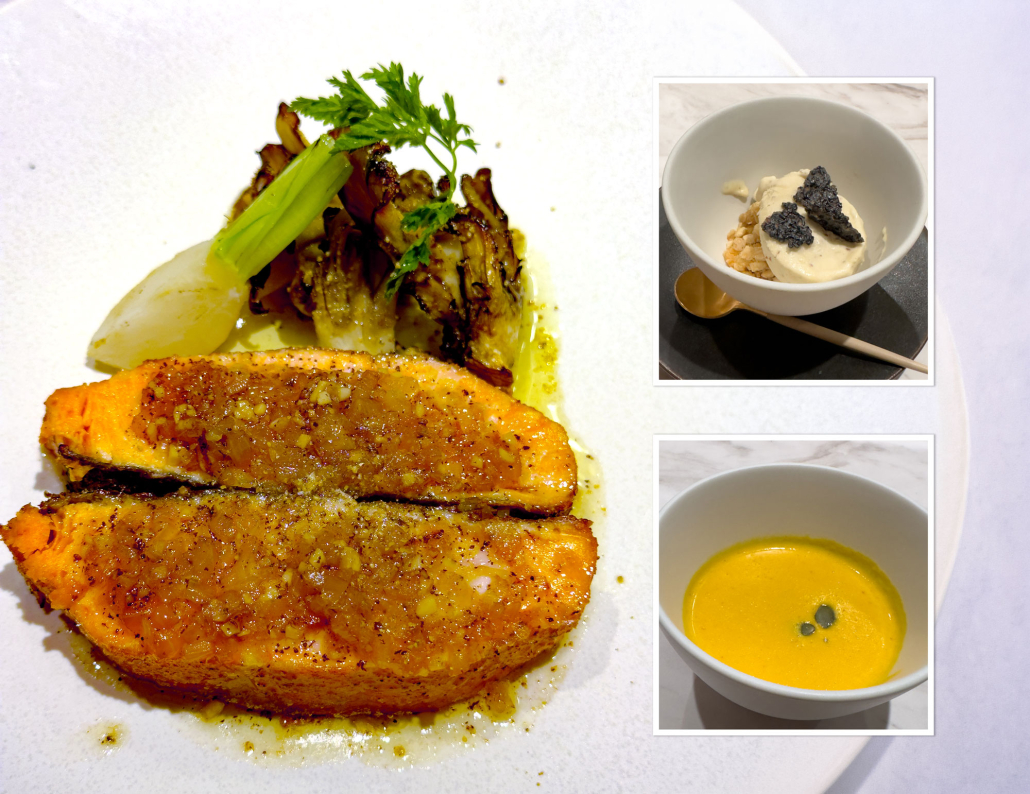
A couple of evenings ago, Charlotte and I had dinner at yet another unassuming neighborhood restaurant that once again delivered far more than what we expected. We ordered four dishes: crispy potato puffs, creamy pumpkin soup, seared salmon with crackling skin, and vanilla gelato with apple pie crumbs. The flavors brought together the familiar and the unexpected – innovative, even, at least to us.
The meal made me think of yōshoku, the Japanese culinary tradition that grew out of adapting Western dishes to Japanese ingredients, flavors, and customs. The dishes we ate were familiar in form, but their flavors and execution felt distinctly Japanese. Nothing seemed to have been changed just for effect or appearance. The familiar had taken on a Japanese character all its own, much like the simple but flavorful tacos we had last night.
Every recipe has its own logic: first the ingredients and proportions, then the order of preparation and the cooking temperatures, and finally the texture the cook wants the dish to have. Only when he or she understands what gives a dish its substance – its soul – can they begin to change it. It means respecting the recipe’s purpose without following it mechanically or slavishly.
I think adaptation works best when it combines thoughtfulness with the courage to take a dish further. Yōshoku is fascinating because it has become a lasting part of everyday life in Japan. At some point, what was foreign was brought in, gradually rooted in local life, and eventually given a life of its own. The process is a kind of translation: you receive something, get to know it, and make it your own. Not by erasing its origins, but by letting it grow into a new setting. Fusion in the truest sense.
I find myself seeing a similar outlook well beyond our Japanese meals. At the same time, I don’t want to turn my visits to Japan into some kind of pseudo-scientific theory about the country. No nation can be summed up by a few simple meals – or by my superficial observations.
Still, I can’t help wondering how much adaptation and refinement have contributed to the country’s modernization and success. The interplay between function and form often seems to be the starting point. In the West, I often feel that design has to give way to function – or else users are expected to put up with impracticality for the sake of appearance. A harmonious balance is often missing.
In Japan, form doesn’t seem to have to be sacrificed for function. I don’t want to make Japan a model for everything or portray the West as its opposite, but I keep noticing the contrast here, and I find it genuinely interesting.
Respect for both function and form can also drive us to refine, polish, and improve things.
Somehow, an object becomes beautiful by being considered, easy to handle, and made to work well – whether it’s a rugged tool, a kitchen knife, a pair of jeans, or a high-speed train. This approach to craftsmanship makes a strong impression on me, perhaps because I recognize some of the same drive in my own creative work.
I’m rarely satisfied with simply repeating myself. For better or worse, my urge to avoid doing so is almost a little obsessive. I want to understand, refine, and see whether something can be made better without losing what makes it itself, whether it’s a photograph, a painting, or a piece of writing.
When I think about the Japanese respect for materials, design, and function, I think of Shinto – not as an all-encompassing philosophy that explains everything (Shinto hardly dictates how a sign is designed or how people behave in daily life), but as a quiet resonance: a reminder that a place or an object may deserve respect beyond its practical use or outward appearance.
I encounter the same kind of thoughtfulness in small, everyday gestures here: a receipt handed over with both hands, a bow that lends dignity even to a brief encounter, people making room for one another at a crosswalk, and a train conductor bowing as they enter or leave a carriage.
That’s it. Thoughtfulness. Perhaps that’s the word I’m looking for.
Perhaps this quiet contract lies in the willingness to receive something new, understand what it is for, and respect it before carrying it forward. It could be a dish, an object, or a shared space. Nothing has to be treated as finished. There is always room to shape, refine, and develop something – with respect for what already works and the courage to take it further.
It’s a contagious outlook, hard not to take on – and bring home.
