
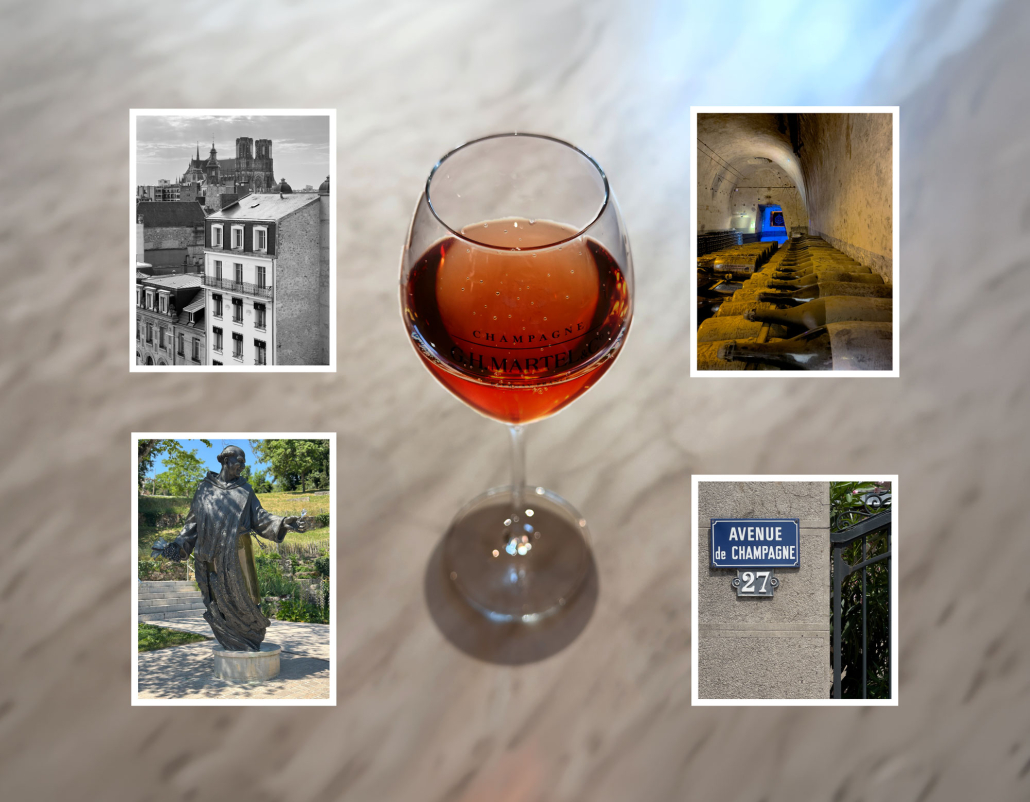
Reims & Épernay: Champagne Days & Caves
Sunday. Evening. Reims. Near heatstroke.
It hit 93°F (34°C) this afternoon by the time we sat down for a late lunch after our last tasting at Maison G.H. Martel.
Our collective sigh of relief we let out in that air-conditioned brasserie probably echoed across the entire dining room.
Next to us sat a newly retired couple from Florida, originally from Cuba. We eventually got to talking politics – turns out they are definitely not fans of “you-know-who” and sometimes even hide their US identity by claiming to be Canadian when traveling.
The night before, we watched the first half of the Sweden vs Holland match from our hotel room bed.
Hunger ultimately beat soccer, and it wasn’t until the main course arrived that we found out about the beatdown in Houston. Still, a solid effort. Japan should be an easy win next, right?
We’ve discovered a great local Champagne hack: regional tourism offices frequently host smaller champagne houses to pour free tastings and share their stories.
And since the French hold journalists/travel writers and photographers in high regard, they love to roll out the red carpet for us – especially when they hear we’re from Sweden. Maybe even a little extra after Saturday night’s loss.
The 10+ smaller houses we’ve visited so far know all about the Swedish state monopoly – how tough it is to get on Systembolaget’s shelves and that private importing is rarely worth the hassle.
What they don’t realize is that a mediocre glass of wine at a Swedish restaurant often costs more than a nice glass of Champagne here in Reims.
This is my third trip to France this year, and I’m continually struck by how incredibly polite and welcoming people have become since my first visit in 1983.
The younger generation speaks far better English than we do French; my local poll suggests many have learned English from watching shows like Friends, just as in Nice and Marseille.
Reims is a fantastic basecamp. Steeped in Roman history, it’s spotlessly clean, has beautifully preserved architecture, and is incredibly easy to navigate via regional train, car, or, even e-bike.
The village of Épernay, also in the official Champagne region, is arguably even more picturesque – and not far from church where Dom Pérignon helped pioneer the use of cork stoppers – but its dining and hotel scene is too small for us. Once you walk up and down Avenue de Champagne, the town feels a bit limited and exorbitant.
Back in Reims, the underground chalk caves (crayères) at Maison Pommery & Greno are an absolute must. Originally excavated by the Romans for building materials, these massive vaults now house millions of aging bottles – mostly Magnums and Jeroboams – alongside massive contemporary art installations. Our self-guided ticket was €30 and came with a glass of delicious bubbles.
Growing up in Göteborg, “The Yellow Widow” (Veuve Clicquot) was the only champagne I knew by name.
Visiting her maison felt nostalgic, even if the brand is now more of a lifestyle empire than a traditional winery. Their gift shop is packed with pricey trinkets – a bit gimmicky, but undeniably lucrative.
The grip that the Comité Champagne (CIVC) has on this region is wild. They function like an international legal army, ruthlessly suing anyone using the name illegally – whether it’s a US soda maker or a local guy printing t-shirts with the word “Champagne” on it.
By fiercely protecting their AOP (Protected Designation of Origin), they keep Champagne synonymous with ultimate luxury while micro-managing local harvests down to the last detail.
The big houses account for 72% of global volume and 79% of total value. The region comprises roughly 410 houses, 120 cooperatives, and over 16,000 growers.
Giants like Moët & Chandon produce some 30 million bottles annually, and Veuve Clicquot hits around 19 million, while the independent growers, which we’ve favored while here, usually produce just 10,000 to 100,000 bottles.
At €5.7 billion ($6.1 billion) in annual revenue, the entire Champagne ecosystem is a massive economic engine, yet it’s smaller than global Swedish tech giants like Spotify.
Behind the luxury lies a grueling, labor-intensive industry reliant on 120,000 seasonal workers every harvest – many stemming from Eastern Europe and West Africa via third-party agencies.
The industry has faced heavy criticism for substandard housing and exploitation of migrant labor. It’s an important part of the reality; luxury always starts with hard manual labor.
As a first-time visitor, I’m genuinely hooked. The intersection of Roman history, ancient craftsmanship, sharp marketing, and label aesthetics is fascinating. I’d love to come back – ideally during the harvest.
Next stop: Paris.
Quick Facts: Reims & Champagne
Reims
-
The Royal Cathedral: Notre-Dame de Reims hosted the coronations of 31 French kings between 1027 and 1825.
-
WWII Ends Here: WWII officially ended in Europe on May 7, 1945, when Germany signed its unconditional surrender inside a Reims schoolhouse serving as Eisenhower’s headquarters.
-
1,800-Year-Old Caves: The city sits on 124 miles (200 km) of Roman chalk tunnels holding a constant 50–54°F (10–12°C)—nature’s perfect cellar.
-
The Smiling Angel: The cathedral’s famous L’Ange au Sourire statue was decapitated by WWI bombs but painstakingly rebuilt as a symbol of French resilience.
-
The Champagne Cookie: Biscuits Roses de Reims (baked since the 1690s) are double-baked to be rock-hard so you can dip them straight into your glass of Champagne without them dissolving.
Champagne
-
Tire-Level Pressure: A standard bottle holds 5–6 bars of pressure—double a car tire and triple a bottle of soda.
-
The Bubble Myth: A single glass holds 1 to 2 million bubbles. Tiny bubbles don’t automatically mean higher quality; bubble size is determined by temperature and glass texture.
-
40 km/h Corks: Flying corks can clock 25 mph (40 km/h). Proffs hold the cork stable and twist the bottle, never the cork.
-
White from Red: Over two-thirds of Champagne is made from red grapes (Pinot Noir and Pinot Meunier), pressed so gently that no color bleeds from the skins.
-
Strictly Hand-Picked: Machine harvesting is entirely illegal. Every single cluster in the region must be picked by hand to prevent damaged fruit from spoiling the press.
