
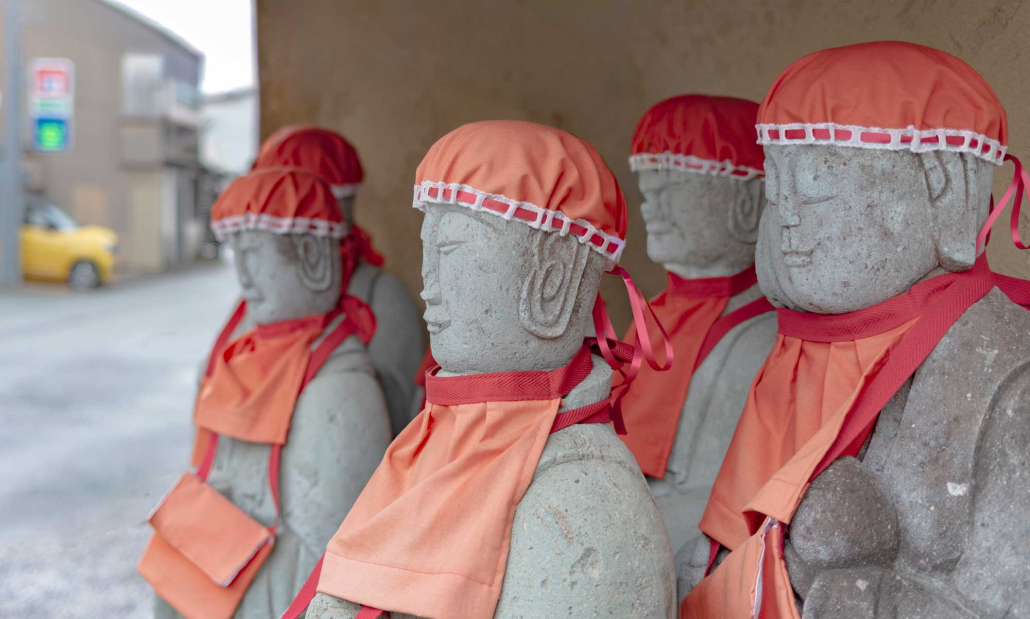
Ojizo-san figures in Kanazawa
On the far side of the bridge by our hotel here in Kanazawa, there’s a narrow side street with a beautiful wooden shrine just off the riverbank. It’s easy to miss. Fortunately, I didn’t.
Under a shallow roof closest to the street, lined up shoulder to shoulder, stand a handful of stone figures. Round faces, closed eyes, soft mouths caught somewhere between a gentle smile and a sigh.
At first glance I thought, ah, monks. The shaved heads, the robes, the calm expressions, the likeness of Buddha – it all pointed in that direction.
A bit of digging later and I learned that these figures are actually Jizō – or Ojizō-san – a bodhisattva, a kind of enlightened being.
In Japan, Jizō is the protector of children, travelers and people who’ve died far from home. Their presence by a bridge and a river makes perfect sense. When most of us think of Buddhism, we picture something more “official.” That world exists here too, of course – the Buddhism you study in books: karma, rebirth, the Four Noble Truths, all of that. But these Jizō statues live in a different, more practical layer of the same belief system.
This is everyday Buddhism – closer to folk religion than formal theology. They don’t need you to understand emptiness or quote a sutra. These figures are more like guardians, protectors or sentinels, patrons of the vulnerable. Atheism aside, I still find this stuff intriguing.

