
Cambridge University: We Need Your Parrot
A buddy of mine reminded me yesterday of something I had completely forgotten about: a photograph of a parrot that I had captured on Maui – licensed by the University of Cambridge for a scientific research paper that has since been published in Nature, one of the world’s most prestigious science journals. Now that the paper has been published, the NDA has been lifted.
It started a few months ago with an email that arrived completely out of the blue. The sender introduced himself simply: “I am Yoonwoo Kim, a Research Associate at the University of Cambridge.”
What followed was a request to license my parrot photograph for use in a scientific paper. Not something that happens every day.
The research itself is genuinely fascinating, even for a non-scientist.
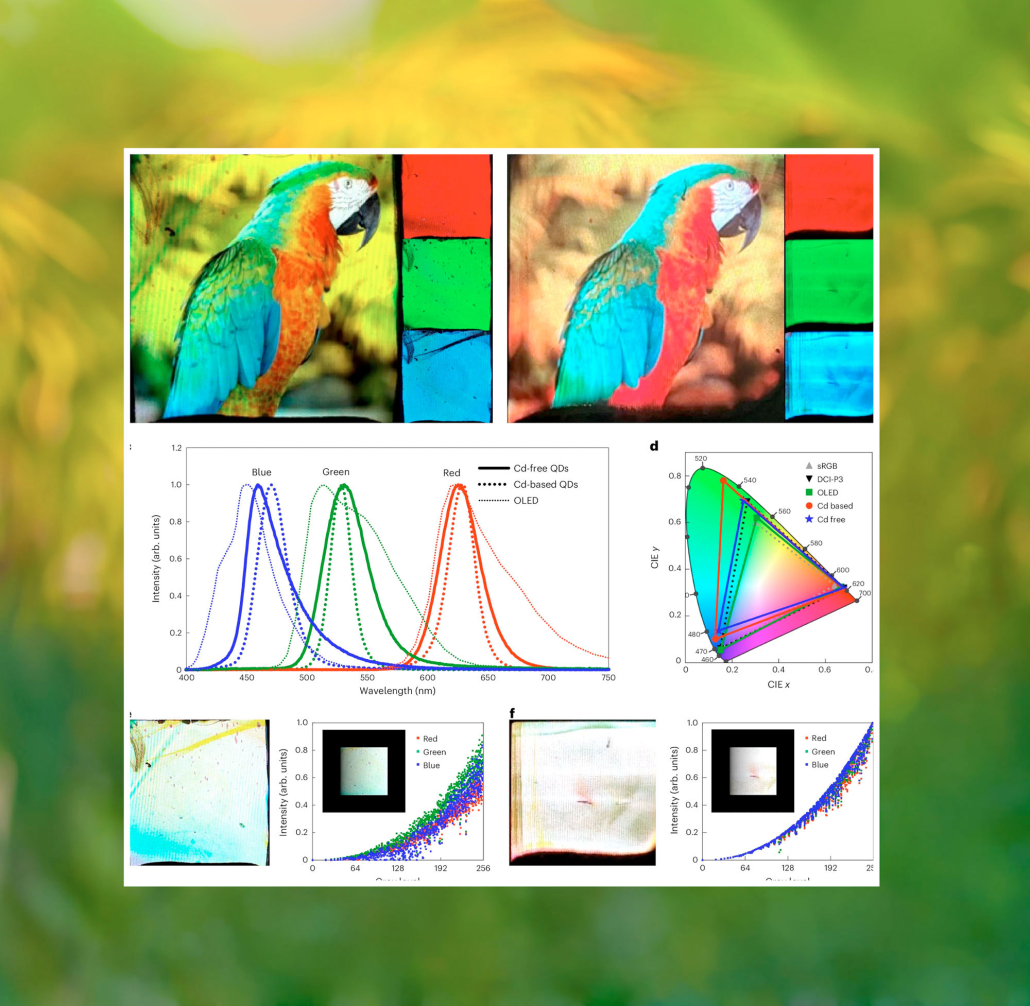
The team at Cambridge has developed a new way to make extremely sharp, full-colour displays using tiny light-emitting particles called quantum dots.
The challenge until now has been placing millions of microscopic red, green and blue pixels precisely onto a screen without them bleeding into each other or losing quality. Their solution is elegantly simple in principle: deliberately introduce controlled microscopic cracks into the quantum dot material before picking it up and transferring it – a bit like scoring a sheet of chocolate before snapping it cleanly. This makes it far easier to lift and place individual pixels with high precision across a large surface.
The result is a cadmium-free – meaning non-toxic – full-colour display roughly the size of a postage stamp, with 341 pixels per inch, sharper than most phone screens, and pixels as small as 600 nanometres, which is actually smaller than the wavelength of visible light. The process also makes the displays brighter and longer-lasting than previous methods.
The technology is aimed squarely at next-generation screens, particularly for augmented and virtual reality headsets, where extremely high resolution in a very small area is everything.
And my parrot? It appears in Figure 4 of the paper, used to demonstrate the display’s colour reproduction.
Somewhere in a Cambridge laboratory, a quantum dot screen is showing the world through my lens. I’ve had images published in many places over the years – but never quite like this.
The full paper is available in Nature Electronics: nature.com/articles/s41928-026-01670-9

